Identity Verification Meetings
PROOF (FKA NOTARIZE) · 2024
Full in-depth case study available upon request
Want to reach out?
hi@jameskibinpark.com
Context
In 2021, Notarize began a strategic shift to offer more than remote online notarization (RON) and e-sign products. The team set to expand new identity verification offerings, leveraging an on-demand agent network as a differentiator.
This project covers the end-to-end process to design an identity verification transaction and meeting experience.
3 months end-to-end
I was the lead designer on 2 teams, coordinating design work across 4 teams. I drove forward the design & discovery process, involving designers on 2 cross-functional teams and stakeholders across legal and operations.
Identity team
🙋🏻♂️ Lead Designer
1 PM
1 Tech lead
1 Front end engineer
4 Back end engineers
1 Engineering manager
Notary team
🙋🏻♂️ Lead Designer
🫥 No PM
1 Tech lead
1 Front end engineer
4 Back end engineers
1 Engineering manager
Cross-functional teams and stakeholders
Signer team
Business team
Legal & Compliance
Customer Support
Notary Operations
External Auditors
Third Party Vendors
Problem
Notarizations were a nice-to-have for most
Many of our customers found it difficult to justify bringing on a new vendor for the single use-case of notarizations. We had to offer more tools in our product suite. In addition, some government documents were shifting from requiring notarization to requiring NIST Identity Assurance Level 2 (IAL2) e-signatures. We had no customer solution to capture this shift in demand.
Fraud was becoming top-of-mind for all
At the same time, consumer fraud was on the rise and posed a liability for Notarize. For example, Zelle has an estimated <1% of fraud, or $725 million in fraud that consumers largely covered in 2023. 1 instance of seller fraud would sink an SMB title agency customer. Customers needed a lower-friction but reliable way to verify an identity ahead of (or separate from) signings.
Deepfake technology becoming widespread
Finally deepfake technology was becoming readily available, potentially crippling for our business if we're not able to rely on what we see on video.
Goals
Launch a new suite of identity products
We set out to launch an identity verification transaction and an audio-video identity verification meeting experience. All of this would expand our TAM and identity verification use-cases. In order to differentiate ourselves and be the best-in-class fraud product, the product needed to pass an audit to receive NIST IAL2 Kantara Certification.
Grow revenue with customers
We wanted to expand our new and existing enterprise accounts by leading with our future vision for fraud monitoring. In addition, we wanted to help notaries retool and provide identity verification services on our platform.
Where did we start?
One of the biggest challenges was working with legal to ensure our solution met NIST IAL2 requirements. I worked closely with a PM and our product compliance counsel to translate legal requirements into UI. I facilitated a design workshop to align our internal R&D team with the Legal Compliance team around risks and potential solutions.
The output of this was an app-flow that I then shopped around to Engineering, Product, Legal compliance, and Operations to ensure we were aligned on general flow of the experience. The product had to impact 4 different apps and account for flows for signers, notaries, B2B customers, and Proof employees.
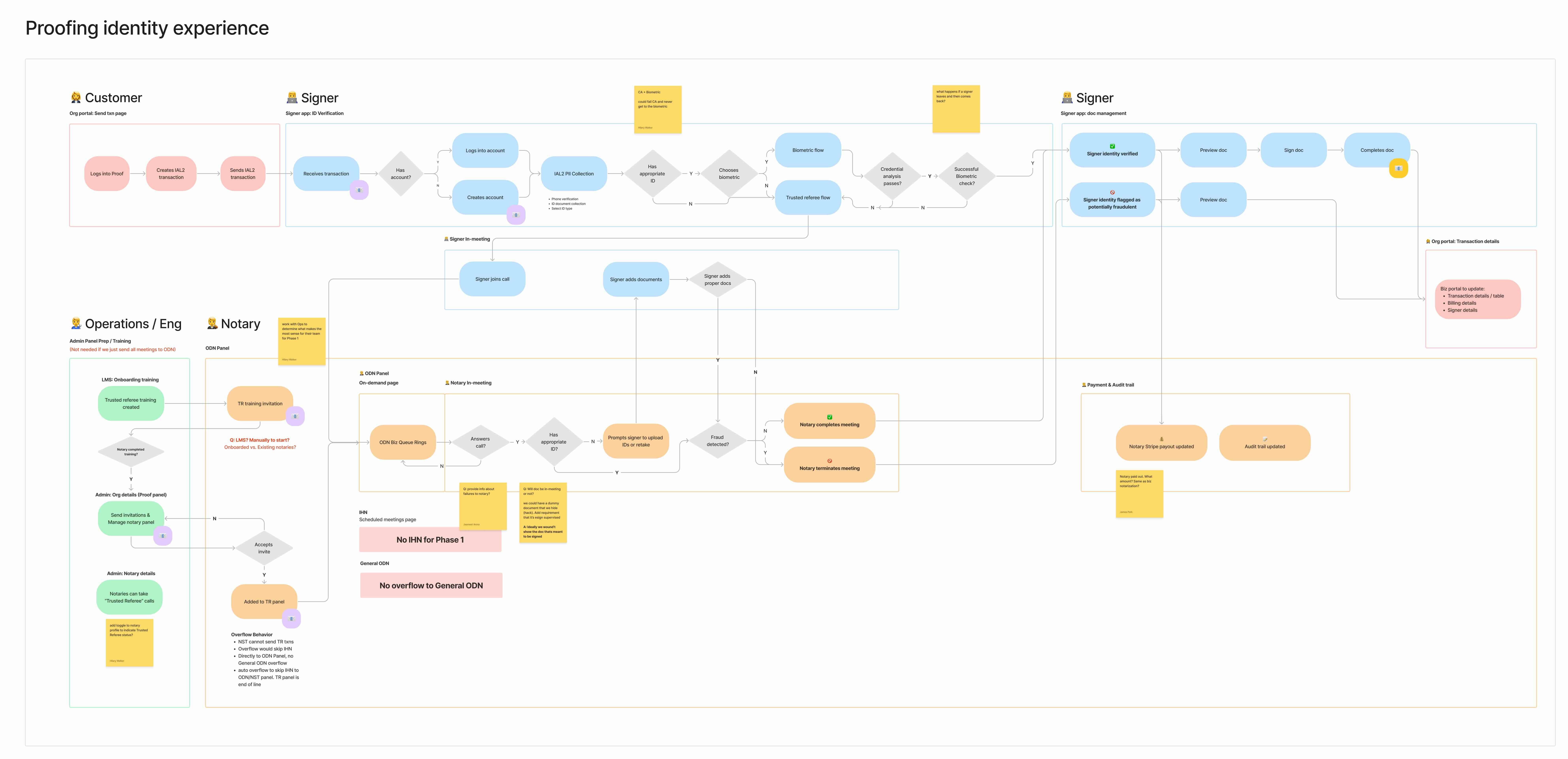
Full app flow of a trusted referee identity verification, validated with internal stakeholders
Internal team feedback
I began with quick sketches that began to organize the necessary elements on the page and communicate the hierarchy of these elements. I used stakeholder design reviews with Legal compliance and Operations to ensure we were capturing all the respective requirements. Separately, I used Design crits, 1-on-1's, and Team lead meetings to collect feedback from the R&D team. At this point I involved a designer on the Signer team to drive forward the meeting UX from the consumer side.
I then created wireframes of different concepts of an experience. One concept focused the experience on clear step-by-step instructions with built-in trainings so every agent can perform IAL2 compliant verifications.
Another concept focused on cross-referencing evidence provided against the consumer's identity information. This concept was more in line with an evidence driven compliance mental model our legal stakeholders. It more intuitively allowed agents to quickly view multiple information sets to make objective claims about an identity.
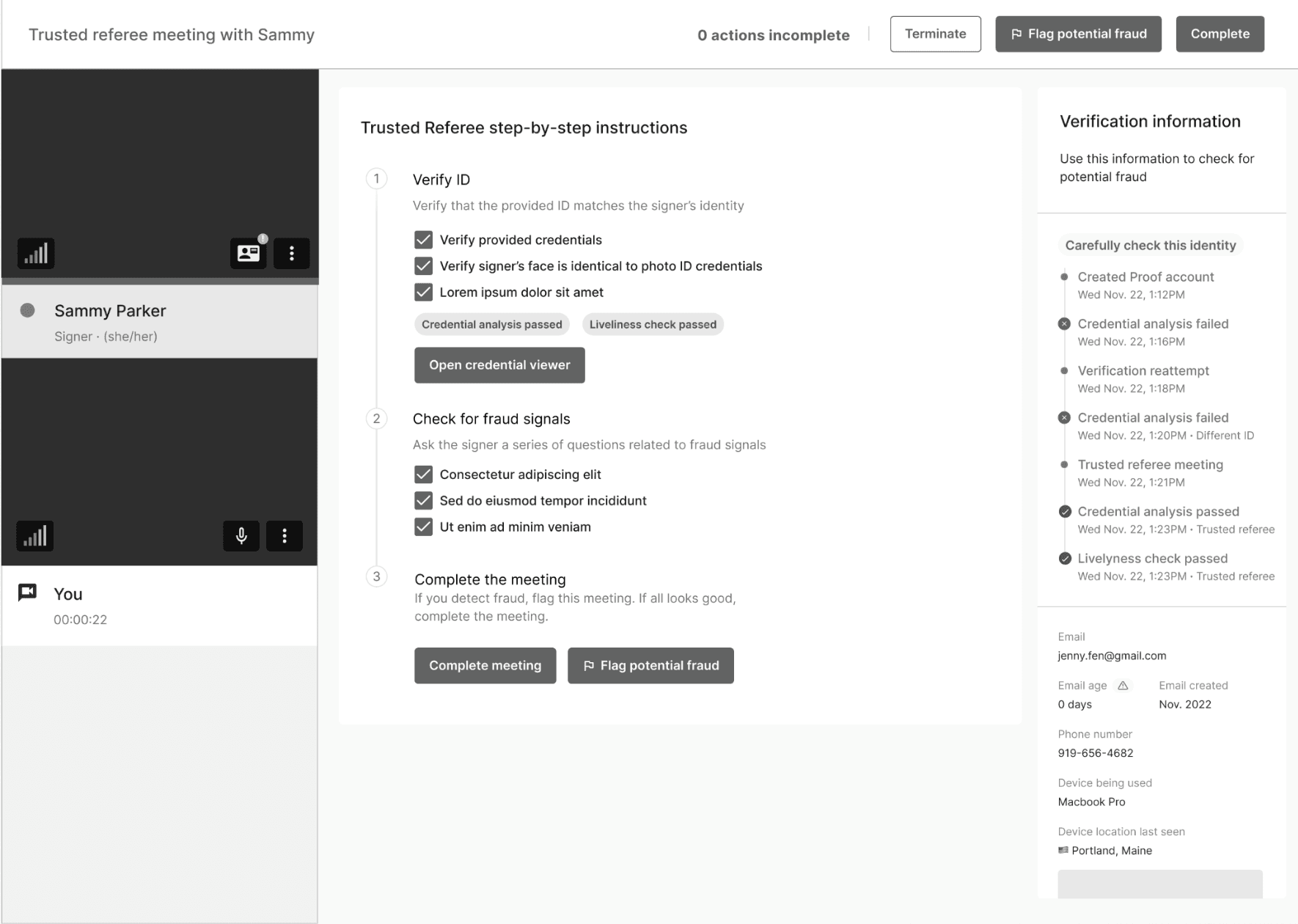
Option 1: Policy driven checklist for identity verification
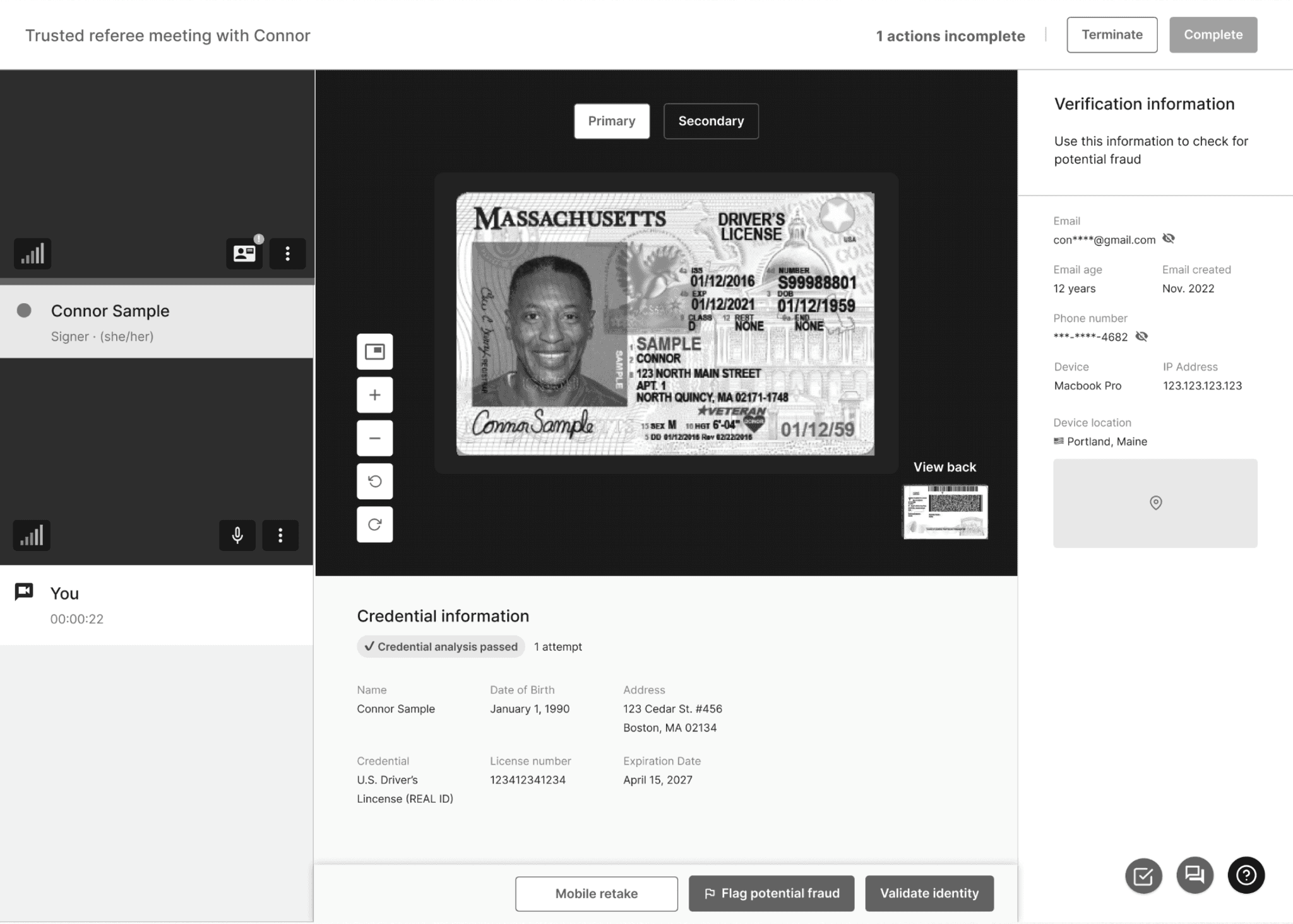
Option 2: Credential viewer focused design with signals
UX Research
We have 1 UX researcher on our team. They help us drive forward our own research at times, and other times they take on the research based on the complexity, which was the case for this project. We decided to facilitate…
Moderated usability testing: 2 wireframe concepts with 4 notaries
Unmoderated usability testing: 1 concept for multiple signers
Notary interview research insights
Informed guidance over overwhelming jargon
Notaries were confused by mentions of IAL2 or technical IDV terms. I had to simplify the design to guide notaries organically through the IAL2 compliant process without getting into the nitty-gritty details of what it all meant.
Marking as fraud was unclear & intimidating
On the meeting completion feedback form, we asked notaries if they thought this was a case of suspected fraud. A binary selection left no room for nuance and caused hesitation. We internally had to have a business conversation to reevaluate the agent’s role in assessing fraud, ultimately shifting the responsibility onto customers to make informed decisions around whether to accept the risk or not. An agent's feedback became 1 signal in a larger picture, as opposed to a declaration of fraud.
Clearer error handling for faster resolution
The design needed a clearer and less redundant ways to resolve blocking errors on an identity. Agents can prompt retakes, or upload alternate forms of evidence to resolve errors.
The product
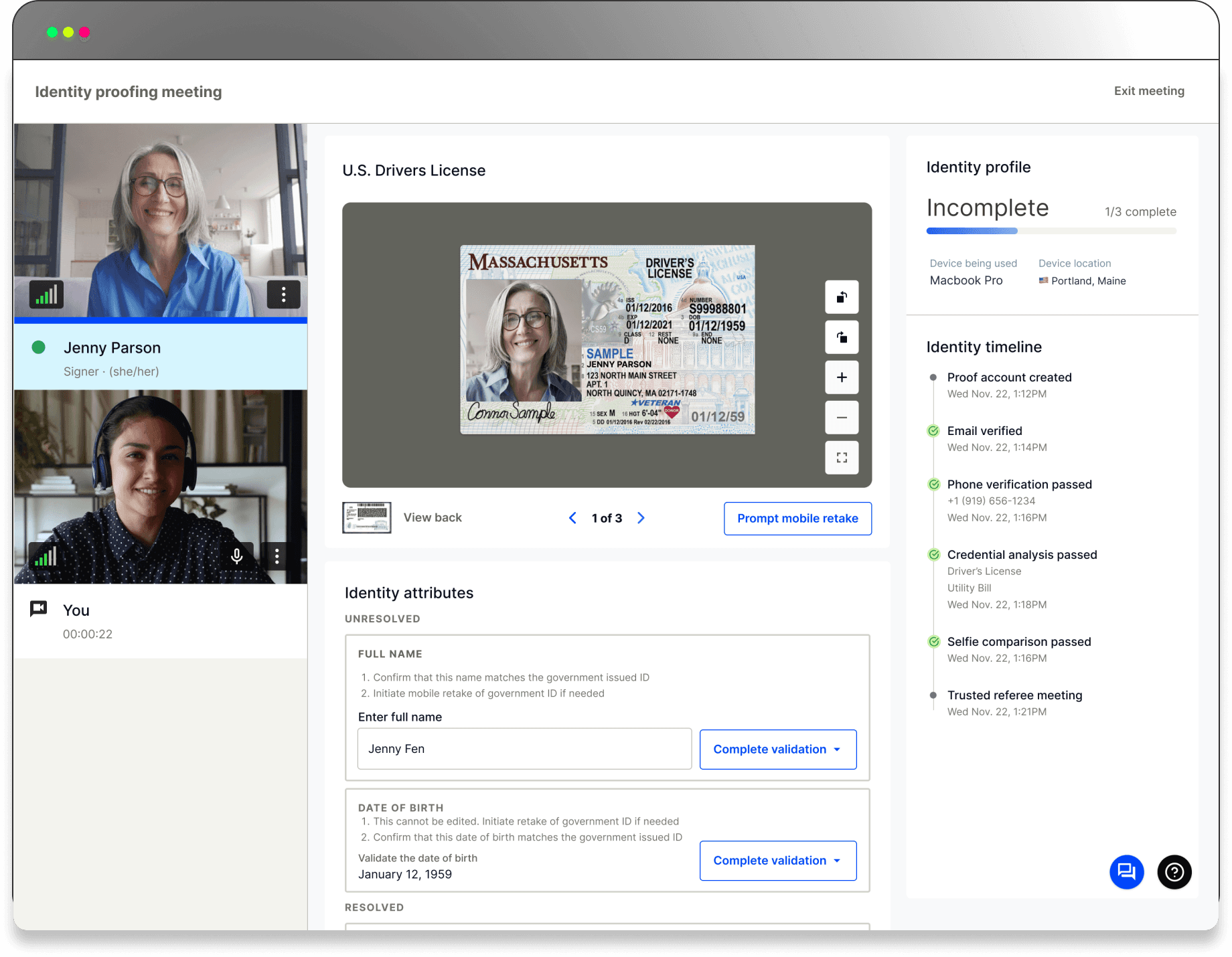
The meeting consists of the credential viewer, identity attributes, identity profile, and the timeline. Agents verify the identity attributes with the provided credentials and evidence in order to complete the verification process of the identity. They are compensated for verifying an identity. Signers can complete their transaction once verified.
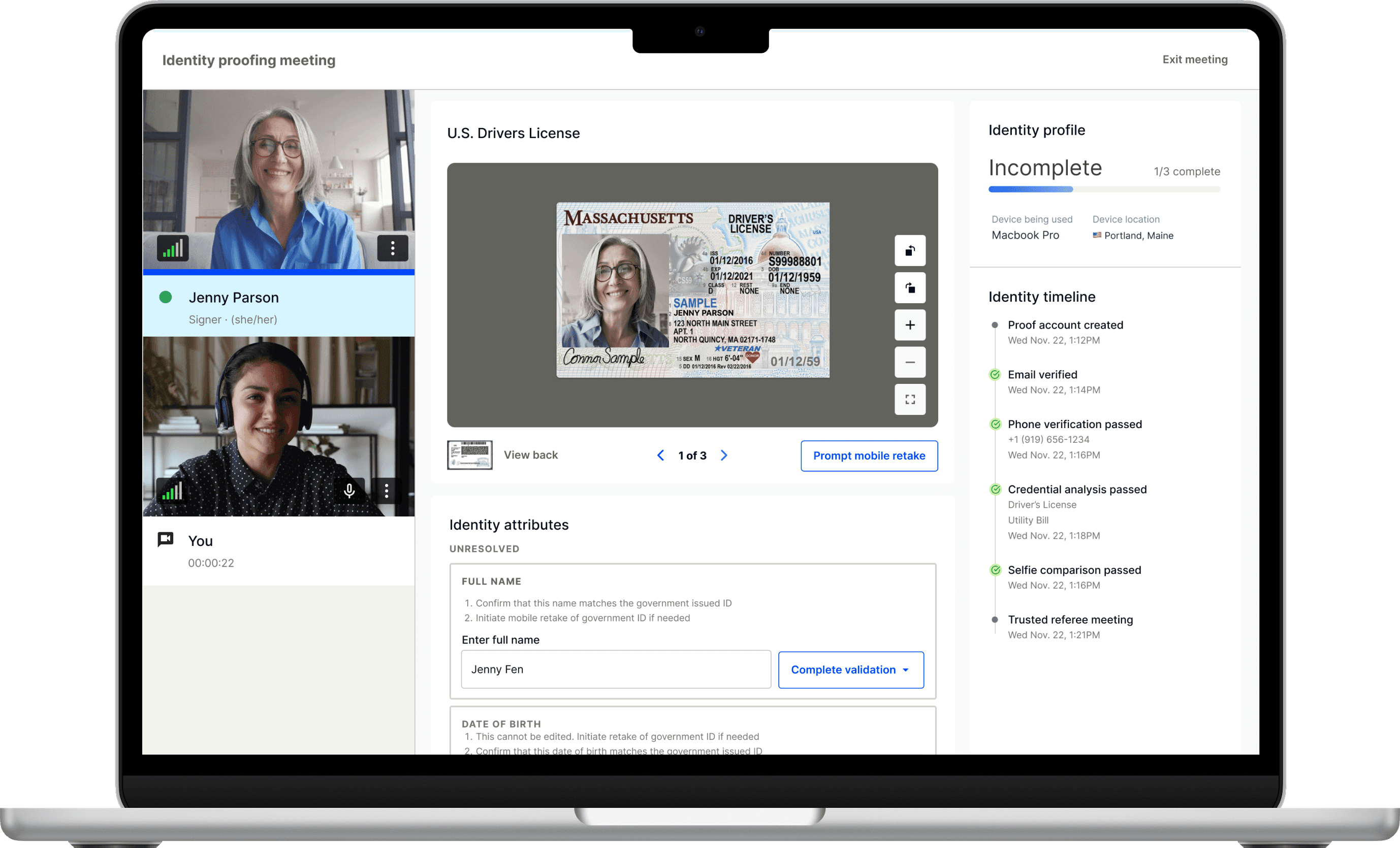
Attribute cards allowed a trusted referee to inspect details of an identity to the evidence provided. Attributes needed to be “resolved” as valid or invalid to complete a meeting. Once all attributes have been resolved, the identity profile will automatically read as invalid or valid, taking the guessing out of the process for the agent. I redesigned the post meeting feedback form to ensure invalid profiles would still receive a payout while they were being sent to the customer for further review.
Finally the identity timeline was designed to communicate any errors to validate an identity. Hard blocking errors prevented a meeting from being completed and were used as speed bumps to conduct more cautious review. Agents had a prescribed action to resolve any hard blocking errors.
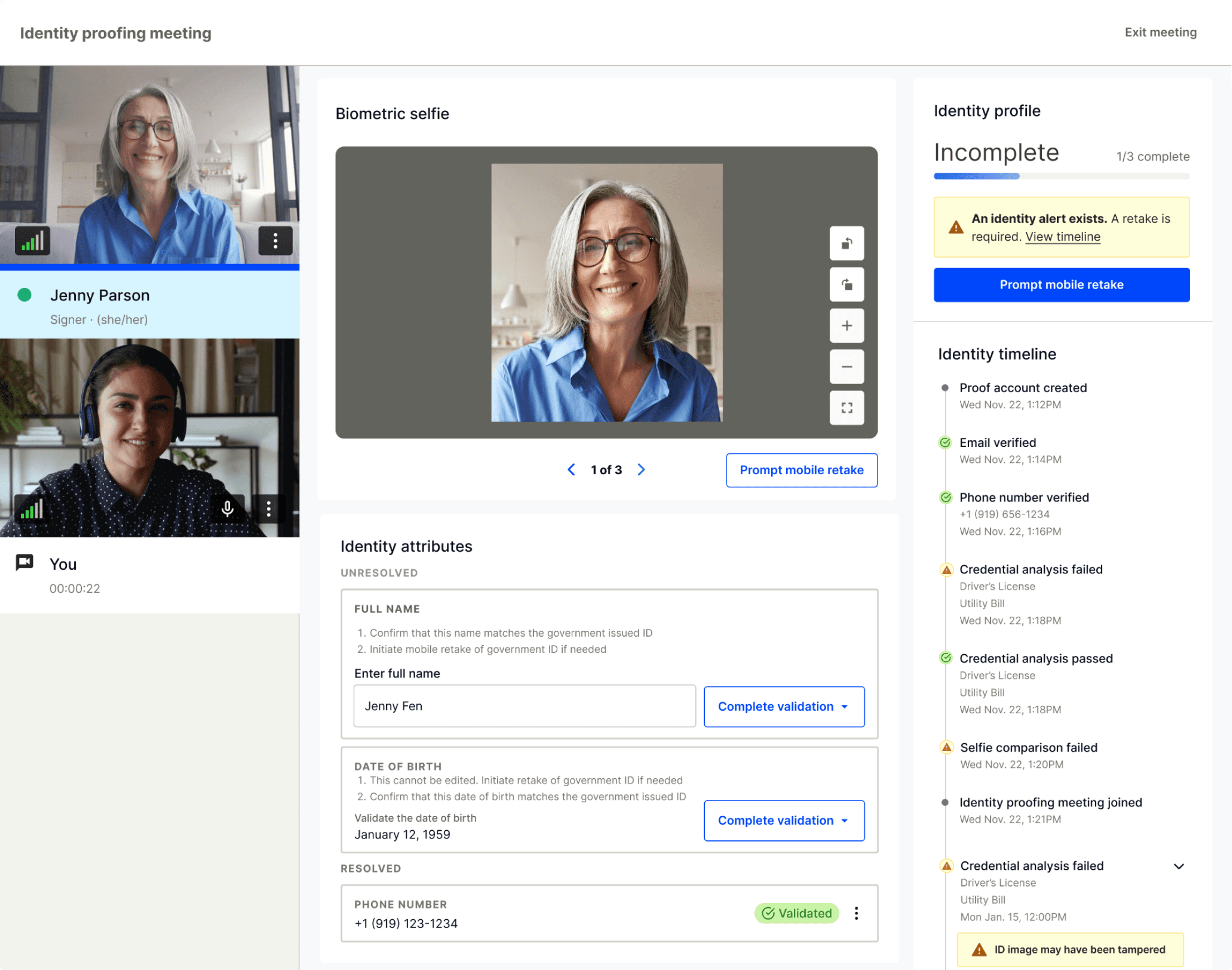
Agents can initiate retakes, and view error alerts for trouble shooting.
Design documentation
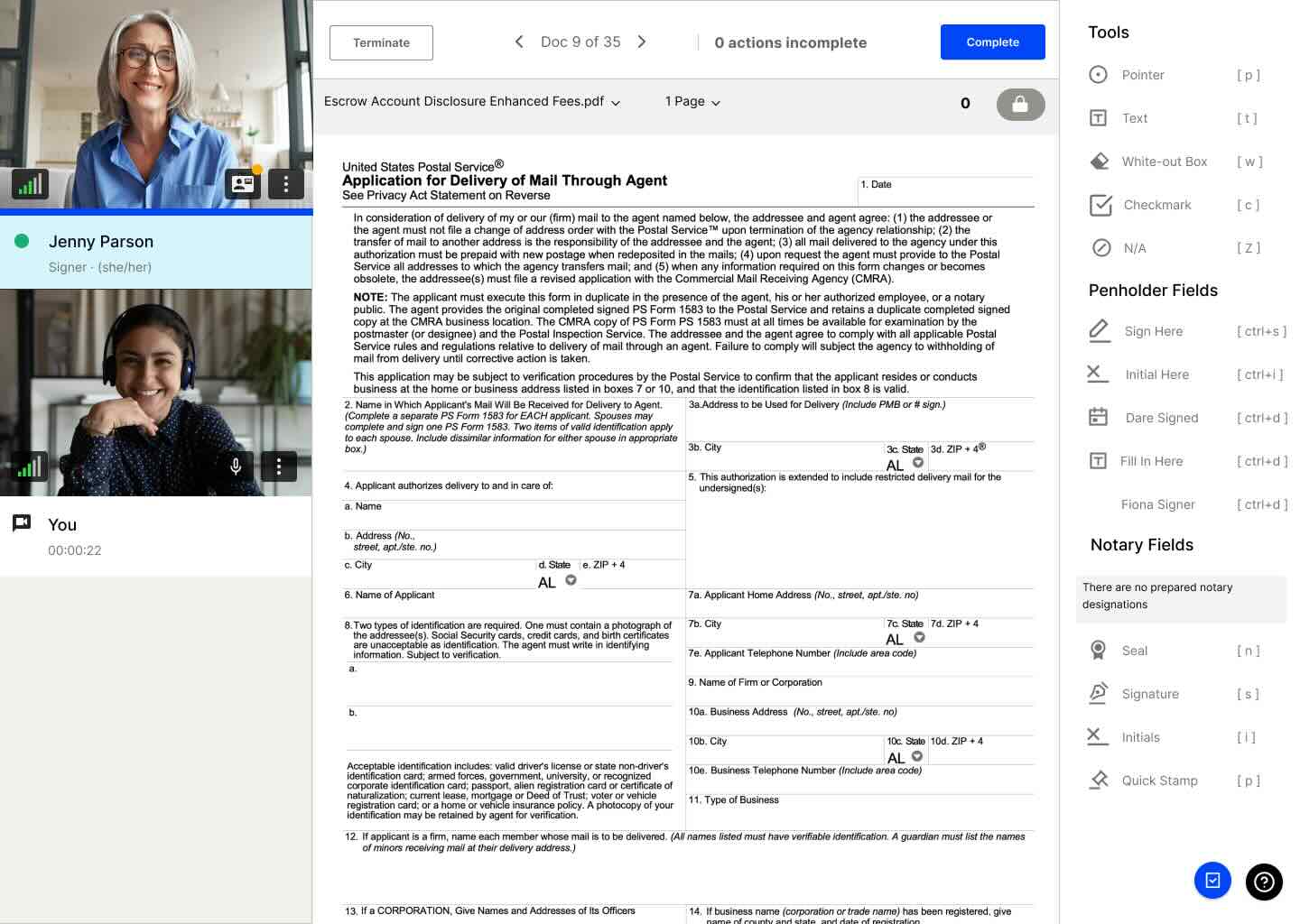
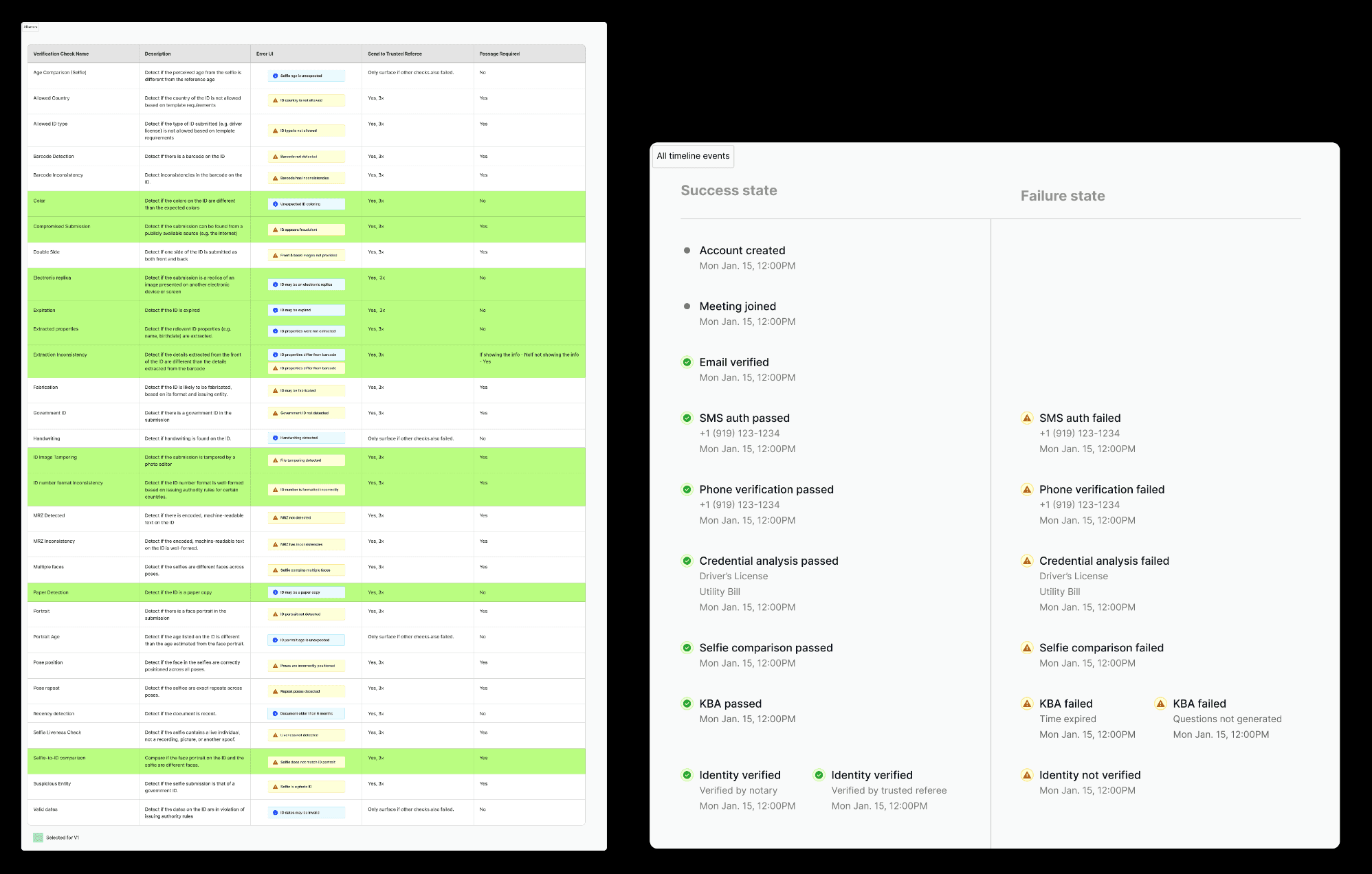
I documented all the potential error states and interactions across the MVP. I met with our front end engineers to communicate the intended behavior, and coordinated with a training designer to create learning resources for our notary agents. For this project, we had dozens of details that had to be properly developed through documentation, async communication, and design QA.
The results
We went GA after an initial beta in 2023
We gained initial learnings with a test group of notaries and launched a few months later.
We gained NIST IAL2 certification on our product
I worked with auditors personally, and demoed our product end-to-end and ensured legal requirements were baked into the flow. We had low resourcing with PMs so I acted as a PM at some points in this process.
We are seeing 2x growth month-over-month of identity transactions sent
We established a baseline fail-over rate, an initial panel of trusted agents, and sent over 2000 transactions in the first 2 months. We're only beginning to scale while continuing to build out our product offerings.
I created a future design vision
Once we shipped the absolute minimal viable product, we had to shift gears to think about what came next. I was asked to create a design vision prototype for the future product experience.
Evolving this into a design vision
We heard a lot of positive feedback around the Trusted Referee product initially. The experience was effective in cases where the customer wanted to enforce the underlying NIST IAL2 compliance framework, but we heard feedback that customers wanted to customize their verification processes in a meeting, therefore not making it so restrictive. I was tasked with creating a design vision prototype in a few weeks to share with our CEO and senior leadership team.
The output of this was a series of storyboards communicated the user journey and a clickable prototype of the vision. The designs focused on visualizing a series of identity verification tools over an audio-video meeting. This was used to inform the future roadmap of our new offering to guide us to product market fit. It began to explore visualization of deepfake detection signals, something we would later productize with a proprietary algorithm.
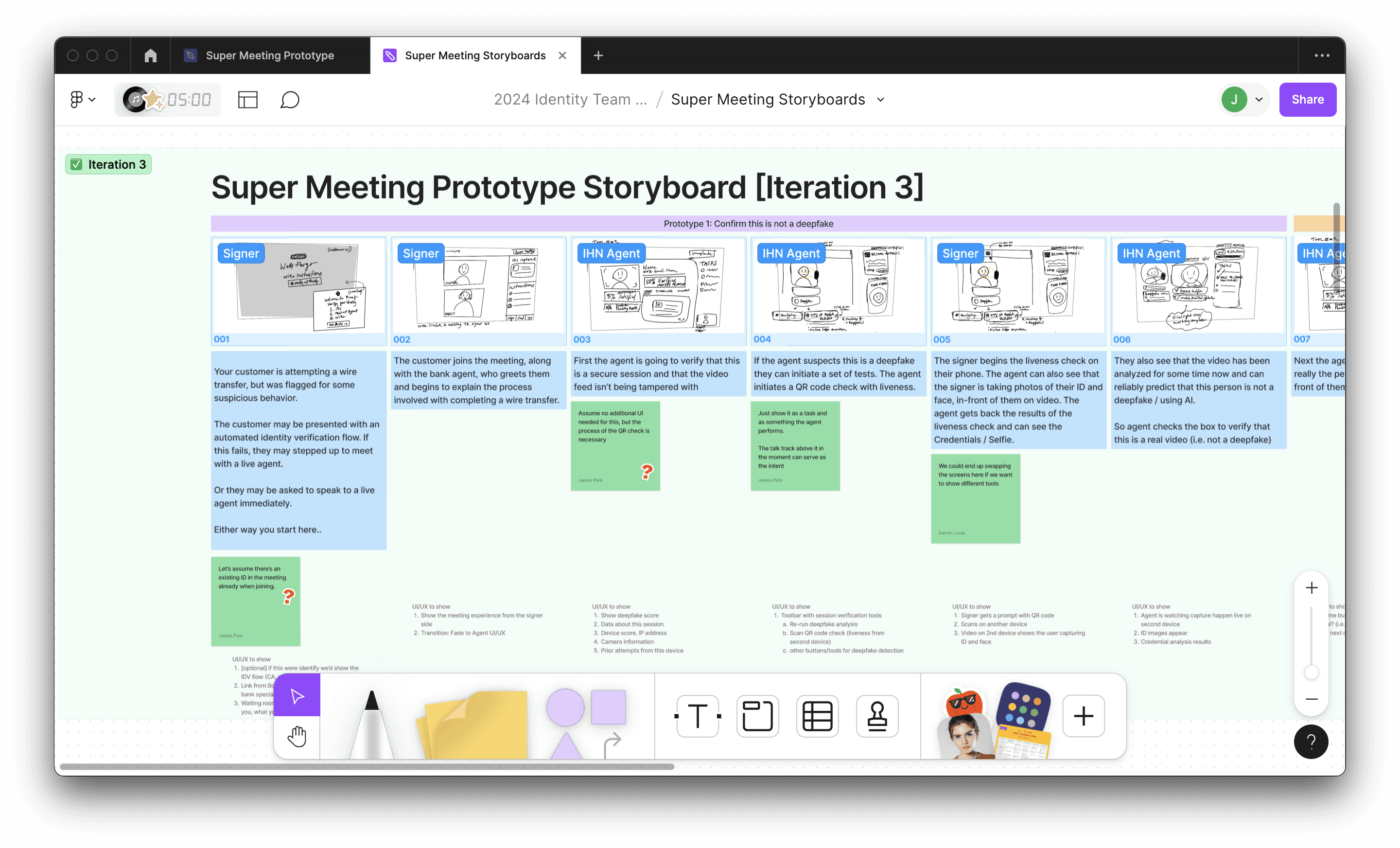
Storyboard used to quickly incorporate feedback and align on a story
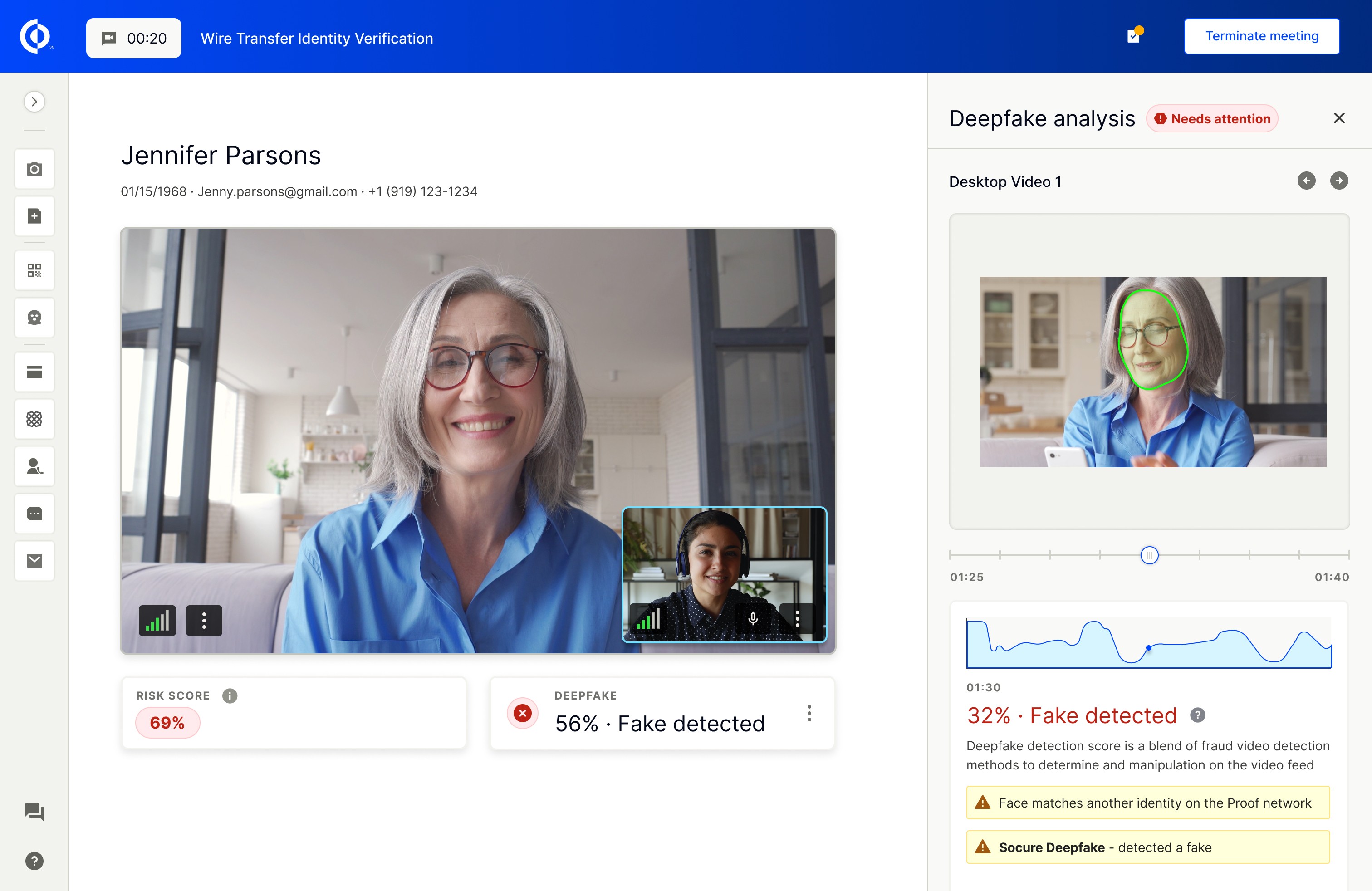
Design vision prototype for customer feedback
Reflections
Personally I also took away a few lessons from this experience…
Design visions can impact the business
Design visions can be used to gain momentum to work towards a shared vision. Often times I underestimated how powerful a visual can be in a business context. The design vision I drove forward helped me identify how energizing this work was for me in my design process.
Designers driving product strategy
During this time stepped in as a substitute PM for one of our teams. I worked with our GTM teams, made product marketing materials, and presented our monthly releases. I sharpened my product strategy skills, which in turn strengthened my skillset as a designer.
Designing solutions for a platform
If I were to approach this project over again, I would stress the importance of design consistency of the meeting experience from the beginning as we begun to deviate from a single meeting.
Offering a standalone identity verification video meeting represented the first step in our transformation from Notarize to Proof. We're continuing to expand identity and fraud monitoring products for notaries, signers, and our customers, while learning more about the problem space.
Thanks for reading
© 2024 James Park. All Rights Reserved.
Contact